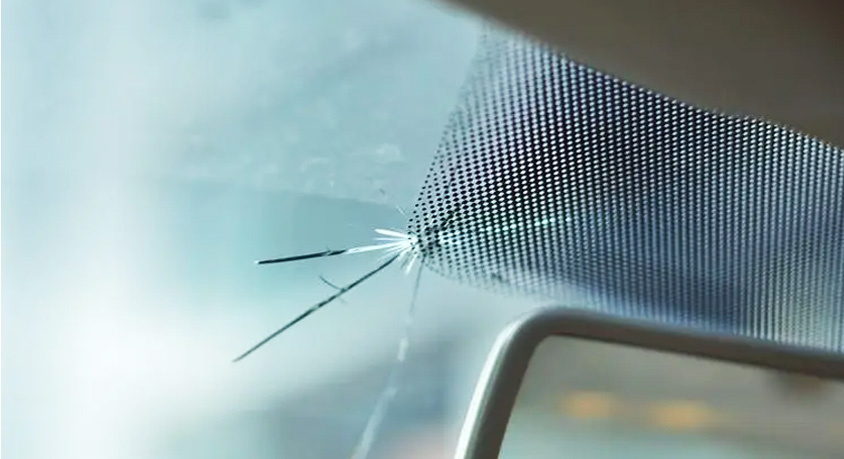
I was hauling a load of drywall back from Home Depot in a borrowed Ford F-150 last November when a rogue pebble kicked up by a semi-truck smacked the glass with a sickening "crack" that sounded like a dry twig snapping in a silent forest. It left a tiny, star-shaped chip no bigger than a ladybug right in my line of sight. Most people would have ignored it, figuring they’d get around to it after the holidays. But I’ve been around the block at Car and Driver long enough to know that small chip wasn't just a blemish; it was a structural invitation for disaster. Three days later, the temperature in Michigan plummeted, I flicked on the defroster, and that "ladybug" instantly mutated into a two-foot-long jagged lightning bolt stretching across the entire dashboard.
Manufacturers love to talk about "active safety suites" and "automated emergency braking," but they rarely mention that your windshield is actually a stressed member of the car's structure. In a rollover, that glass is responsible for up to 40% of the cabin's structural integrity. Yet, we treat it like a disposable screen protector on a cheap smartphone. I have a particular, burning hatred for the "acoustic glass" found in some modern luxury sedans—looking at you, Mercedes and Audi. They claim it makes the cabin as quiet as a cathedral, but it feels as fragile as a wine glass. You sacrifice the rugged, battle-hardened reliability of traditional glass for a slightly quieter podcast experience, and the second a pebble touches it, the whole laminate layer panics.
The physics behind that "sudden" crack is simple thermal expansion, and it doesn't care about your schedule. Think of your windshield as a tightly wound spring held together by layers of plastic and glass. When you’re driving through a tropical monsoon in Southeast Asia, the exterior glass is being lashed by cold rain while the interior is sweltering. Or, in a brutal American winter, the outside is 10°F while your vents are blasting 120°F air directly at the base of the glass. That temperature differential creates a tug-of-war within the glass layers. A chip is a weak point, a "stress riser" where the glass has already given up. When those layers expand at different rates, the chip acts as the starting line for a race that ends with you spending $1,200 on a full replacement.
I’ve always preferred the straightforward, honest glass in a Jeep Wrangler or an older Toyota 4Runner over the tech-heavy nonsense in a Tesla Model X. Tesla’s massive "panoramic" windshield is a masterpiece of vanity; it’s beautiful until you realize it costs more to replace than a used Honda Civic because it’s packed with sensors that require recalibration by a technician who charges by the minute. If you’re a guy who likes to get grease under your fingernails and fix things yourself, you’ll appreciate a car that doesn't require a software update just because a rock hit the window. A simple windshield in a truck feels substantial, like the grip of a well-worn baseball bat, whereas these modern panoramic units feel like you’re driving inside a very expensive lightbulb.
When you ignore a chip, you’re also allowing moisture and road grime to seep into the plastic interlayer (the PVB). Once that dirt gets in there, even the best resin repair kit won't make it disappear. You’ll be left with a permanent "ghost" in your vision. If you catch it early, a $15 DIY resin kit can seal that wound and save the structural integrity of the pane. It’s a satisfying twenty-minute job—cleaning the area, setting the bridge, and watching the resin disappear into the crack. It’s the kind of maintenance that separates a true owner from someone who just pays a lease and hopes for the best.
Let’s be honest: modern car design is moving toward making everything a "total loss" component. They don't want you to repair; they want you to replace. They bury rain sensors, heads-up display coatings, and lane-departure cameras inside the glass. This makes the windshield the most vulnerable and expensive "sensor" on your vehicle. If you’re taking the kids to soccer practice or embarking on a cross-country road trip, the last thing you want is a structural failure triggered by the very heater meant to keep you warm. A cracked windshield isn't just an eyesore; it’s a compromised shield.
Next time you hear that "tink" on the highway, don't wait. Pull over, put a piece of clear scotch tape over the chip to keep the dirt out, and fix it as soon as you get home. Don't let the car companies win by forcing you into a four-figure glass replacement because you were too busy to spend twenty minutes with a resin tube. In the world of automotive longevity, the small stuff is what kills you. Respect the glass, understand the thermal stress, and keep your money in your pocket where it belongs. After all, the best view of the road is the one that isn't interrupted by a $1,200 mistake.
Disclaimer: Mention of any brand or trademark is for identification only and does not imply partnership or endorsement