I was coming down the back side of the Blue Ridge Parkway in a friend’s Toyota 4Runner five years ago. We’d spent the morning exploring gravel roads, and now we were descending a steep two-lane with a drop on the passenger side that made my palms sweat. The brakes felt fine at first. Normal pedal. Normal bite. Then, about the third time I hit the brakes for a tight switchback, something changed. The pedal got soft. Not spongy—soft. Like stepping on a loaf of bread. I pushed harder. The truck slowed, but not with the confidence it had five minutes earlier. By the fifth corner, the pedal went almost to the floor before anything happened. I pulled off onto a gravel turnout, let the brakes cool, and tried to explain to my friend that his $40,000 off-road machine was one corner away from sending us into the trees because he hadn’t changed the brake fluid in seven years. He looked at me like I was speaking ancient Greek. He changed the fluid the next week. The pedal came back like a new truck. And he still talks about that day like I saved his life. I didn’t. Physics did. And physics doesn’t care about your oil change schedule.
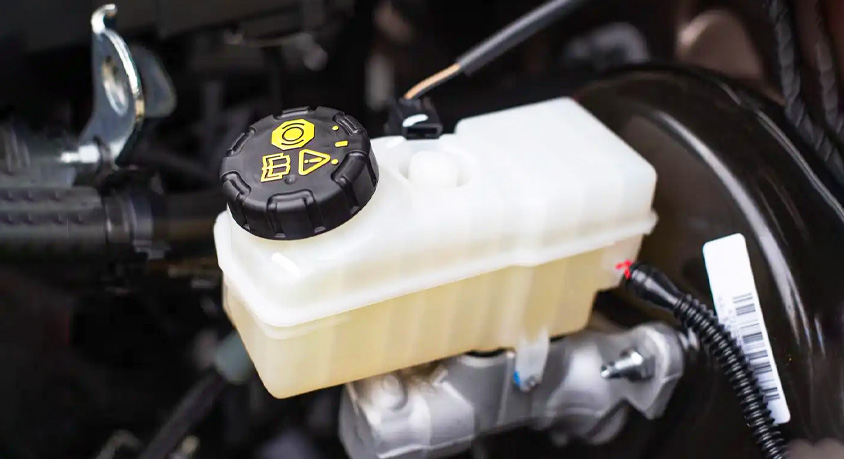
Let’s talk about the most neglected fluid in your car. Not oil. Not coolant. Brake fluid. You’ll hear people obsess over synthetic vs conventional oil, argue about transmission fluid intervals, but ask them when they last flushed their brake fluid and they’ll stare at you like you just asked about blinker fluid. Here’s what’s happening inside your brake system that nobody tells you. Brake fluid is hygroscopic. That’s a fancy way of saying it’s a sponge. It pulls moisture out of the air through the tiny vent in your master cylinder reservoir. Over time—usually about two to three years in a humid climate—that fluid absorbs enough water to change its entire personality. Fresh DOT 3 or DOT 4 fluid boils at around 400 to 450 degrees. Fluid with three percent water content boils at around 300 degrees. And guess what happens inside your brake calipers when you’re coming down a mountain pass, or stuck in stop-and-go traffic on a 95-degree day, or towing a trailer through the Appalachians? Those temperatures climb fast. Three hundred degrees is not a hard number to hit. And when fluid boils, it turns to vapor. Vapor compresses. Brakes don’t compress. They rely on incompressible fluid to transfer force from your foot to the caliper piston. When you get vapor in the lines, the pedal goes soft. Then it goes to the floor. Then you go wherever gravity and momentum decide to take you.
The sensory experience of brake fade is unmistakable once you’ve felt it. It starts as a change in pedal texture. A fresh brake system feels like stepping on a concrete block. Solid. Immediate. That’s confidence. Old, waterlogged fluid gives you a pedal that feels like it’s padded with memory foam. You push, and it sinks. You push more, and it keeps sinking. And if you’re really unlucky, you’ll get the smell. Hot brakes have a distinct odor—burnt clutch, hot metal, and a faint chemical sweetness from boiling fluid. I’ve smelled it on a Ford F-150 towing a boat up a ramp. I’ve smelled it on a Subaru Outback coming down a ski resort access road. Every time, the driver had no idea their brake fluid was two years past its prime.
Here’s where the car manufacturers deserve some blame. They’ll put a “lifetime” fluid label on things that absolutely have a finite life. BMW and Mercedes used to claim their brake fluid was good for two years, then quietly extended it to three. Toyota says check it, but rarely gives a hard interval in miles. The result is that a Honda Accord driven by someone who only goes to the dealership for oil changes will go 60,000 miles on the factory brake fluid, absorbing moisture the whole time, until one panic stop on a hot day reveals the truth. Compare that to a properly maintained Mazda CX-5 where the owner flushes the fluid every two years. That Mazda will stop shorter, feel more consistent, and the brake calipers won’t seize up from internal corrosion caused by water sitting in the system for years.
The corrosion piece is the part that costs you money long before a brake failure does. Water in the brake fluid doesn’t just lower the boiling point. It rusts the inside of your brake lines, your caliper pistons, and your ABS pump from the inside out. I’ve replaced ABS modules on Volkswagen GTIs that failed at 80,000 miles because the fluid was never changed and the internal valves corroded shut. That’s a $1,200 repair that a $10 bottle of DOT 4 and an hour of your time could have prevented. The same goes for Subaru. Their brake calipers are notorious for seizing in salt-belt states, and while road salt is part of the problem, old, water-saturated fluid accelerates the corrosion inside the caliper bores until the piston can’t retract.
I’m not telling you to become a brake hydraulics expert. I’m telling you that this is the single cheapest, easiest piece of preventive maintenance you can do, and it has the highest potential consequence if you ignore it. A brake fluid flush on a Toyota Camry takes one person, a bottle of fluid, and a basic bleeder kit. On a Honda Civic, it’s the same. On a Ford F-150 with ABS, you might need a scanner to cycle the pump, but the fluid itself is still $15. Compare that to replacing a rusted brake line on a ten-year-old car—a job that involves dropping fuel tanks or removing interior trim and runs $500 to $1,000 at a shop.
Here’s my rule, and it’s served me well across two decades of driving in mountains, deserts, and Midwest winters. Flush your brake fluid every two years, or every 30,000 miles, whichever comes first. Use a quality DOT 4 fluid—it has a higher dry boiling point than DOT 3 and is compatible with almost every modern car that doesn’t specifically require the racing-oriented DOT 5.1. If you live in a humid climate like Florida or the Gulf Coast, do it annually. If you tow, do it annually. If you drive mountain roads for fun, do it before every season of serious driving. The cost is negligible. The time is minimal. The difference in pedal feel is immediate and satisfying. And the alternative—finding out your fluid has turned to steam halfway down a canyon road—is a lesson you might not get to learn twice.
That 4Runner I mentioned earlier? My friend still owns it. It has fresh brake fluid in it right now. He checks it every spring. The pedal feels like a brick wall. And every time he drives down a steep grade, he remembers that afternoon when a $10 bottle of fluid was the only thing standing between him and a very bad day. Don’t wait for that memory. Do it now. Your brakes are the only thing between you and whatever’s in front of you. Treat them like it.
Disclaimer: Mention of any brand or trademark is for identification only and does not imply partnership or endorsement